
Concrete Block Making Business Feasibility in Pakistan: The 2026 Investor’s Blueprint
1. Market Demand & Future Industry Trends
The market demand for concrete masonry units (CMUs) in Pakistan is driven by structural economics. A standard $12 times 8 times 4$-inch hollow concrete block replaces roughly four to five traditional clay bricks. It requires up to 30% less mortar to lay, significantly accelerates the construction timeline, and offers superior thermal and acoustic insulation.
Forward-Looking Trends (2026 to 2030):
- The Lab-Tested Compressive Strength Mandate: Private housing schemes and government consultants no longer accept hand-mixed, low-pressure blocks that crumble during transit. Contracts now legally enforce strict minimum thresholds of 3,000 to 5,000 PSI. Meeting these specifications requires high-tonnage hydraulic compression coupled with dual-shaft synchronized vibration.
- The Rise of Fly Ash and Green Concrete: Environmental mandates are pushing the industry toward sustainable aggregate blends. Forward-thinking factory owners are integrating industrial fly ash and slag into their mix designs, which lowers production costs while maintaining high structural density.
- Diversification into Interlocking Pavers (Tuff Tiles): Urban infrastructure, parking plazas, and motorway service bays are heavily dependent on interlocking pavement. The most profitable block factories utilize versatile machinery where a single operator can swap a hollow block mold for a tuff tile mold in under an hour.
2. Technical Machine Specifications & Selection Matrix
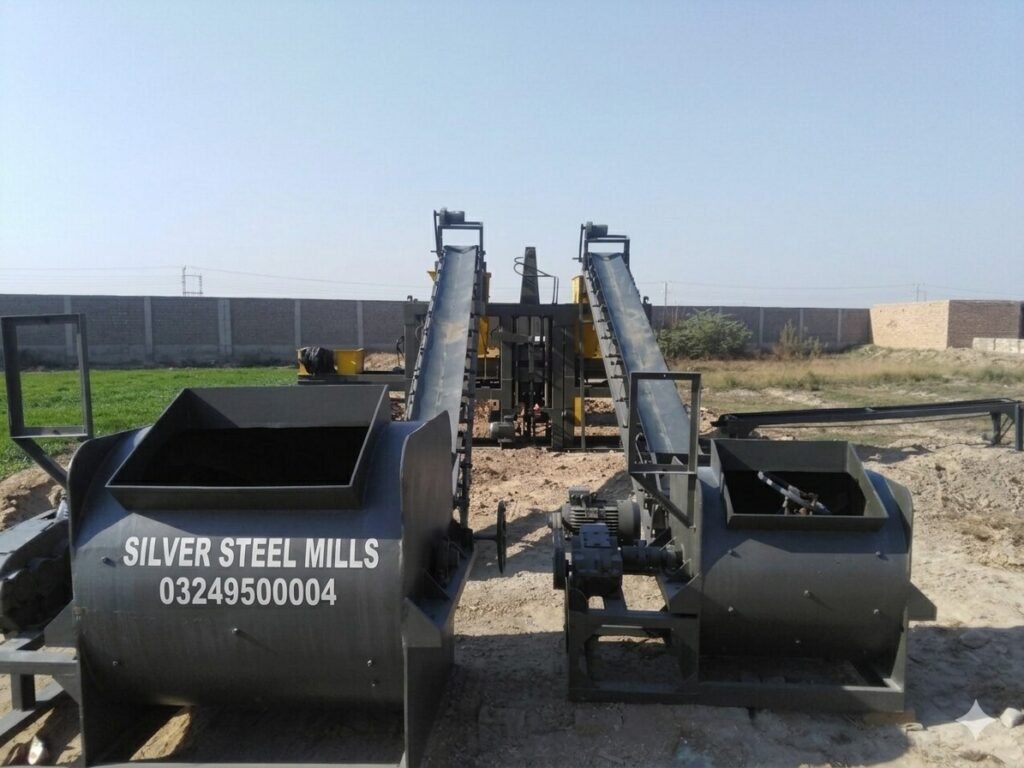
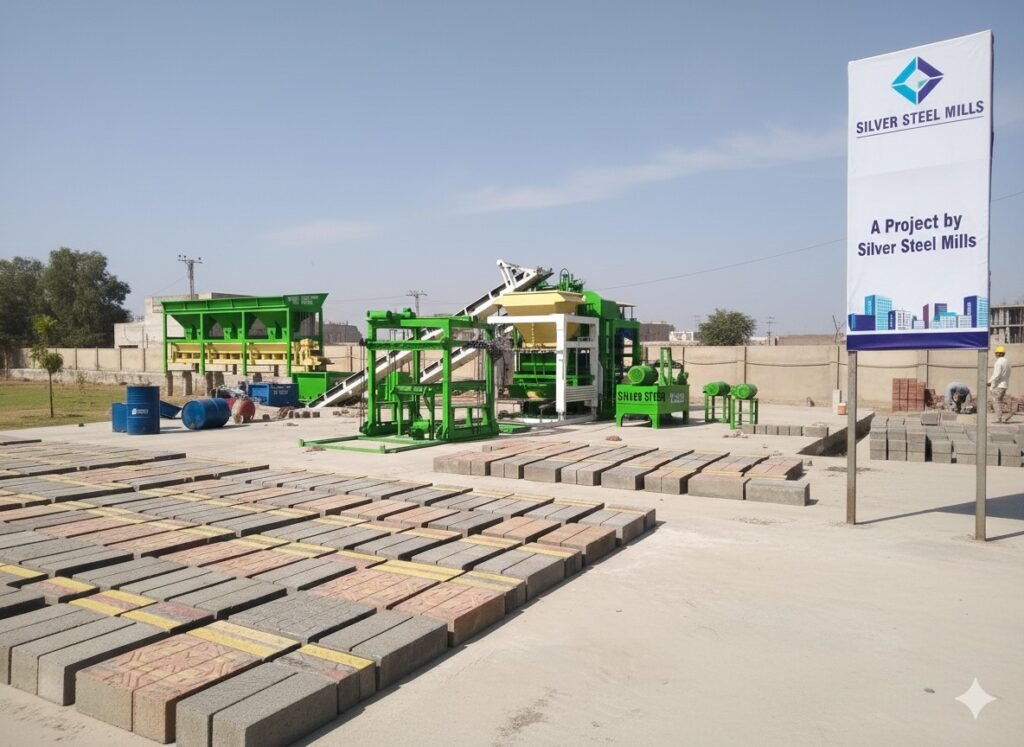
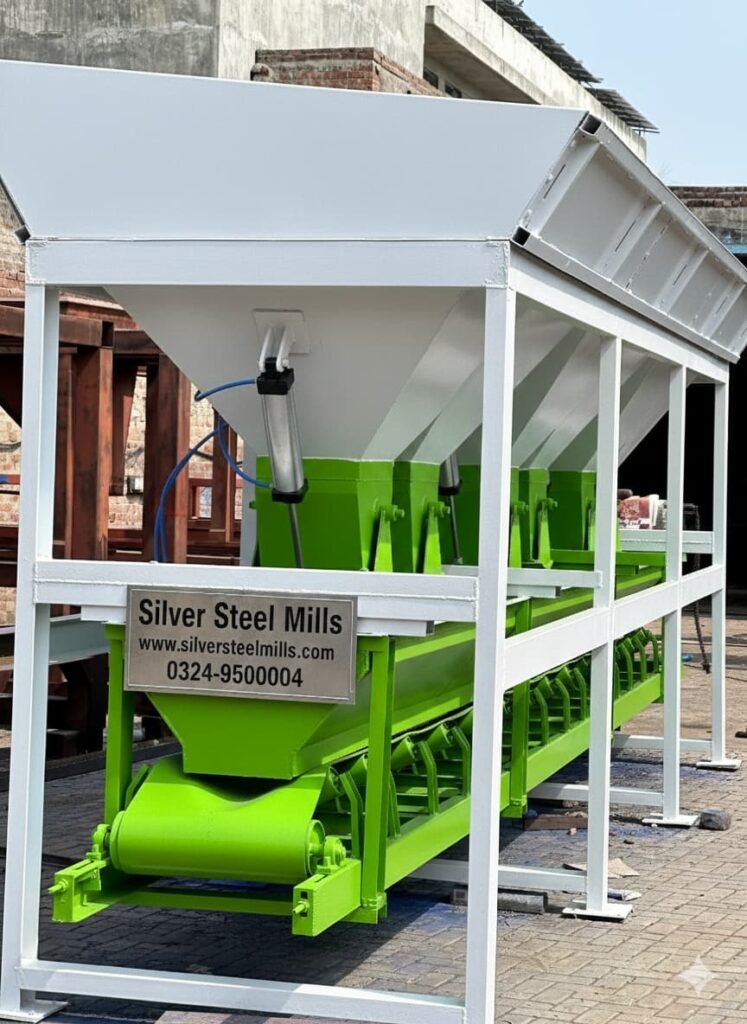
The heart of your factory is the core vibro-compression machine. New investors frequently fall into the trap of buying cheap, under-engineered machines from unverified local workshops that weld recycled scrap metal and mask the structural flaws with a shiny layer of paint.
At Silver Steel Mills, we fabricate plants using only certified, brand-new prime steel plates (14mm to 24mm thick) capable of absorbing continuous high-frequency harmonic cycles without stress fracturing.
Technical Parameters Checklist
| Engineering Parameter | Semi-Automatic Tier (S-18 / S-24) | Fully Automatic PLC Plant (S-35 / S-50) |
| Main Frame Metal Thickness | 14mm to 16mm High-Tensile Plate | 18mm to 24mm Solid Cast Steel |
| Hydraulic Pump Operating Pressure | 120 to 160 Bar | 180 to 240 Bar |
| Vibration System Frequency | 3,000 to 3,600 RPM | 4,200 to 4,800 RPM (Variable Frequency) |
| Molding Cycle Speed | 22 to 30 Seconds per Drop | 12 to 18 Seconds per Drop |
| Hydraulic Valve Assemblies | Brand-New Industrial Directional Valves | Rexroth / Scaled Precision Proportional Valves |
| Automation Integration | Manual Hydraulic Levers | Siemens PLC Touch-Screen Interface |
| Structural Net Weight | 3.8 to 5.5 Tons | 8.5 to 15.0 Tons |
3. Real-World Production Capacities
Your daily capacity dictates your cash flow and defines which tier of commercial tenders you can realistically secure. The table below represents actual production outputs over a standard 8-hour shift at 85% operational efficiency.
| Machine Configuration | 8-Inch Hollow Blocks (12×8×4 inches) | Standard Brick Substitutes | Interlocking Tuff Tiles (Uni / Double-Hex) |
| S-18 Semi-Automatic | 2,200 – 2,800 Units | 10,000 Units | ~2,500 Units |
| S-24 Industrial Unit | 3,500 – 4,500 Units | 18,000 Units | ~4,000 Units |
| S-50 Mega Automatic PLC | 10,000 – 13,000 Units | 55,000 Units | ~12,000 Units (Dual-Layer Colored) |
4. Space, Infrastructure, & Utility Requirements
Miscalculating your land layout creates severe spatial bottlenecks that slow down your forklifts and damage fresh, uncured blocks.
Total Land Footprint
- Semi-Automatic Plant: Requires a minimum of 3 to 4 Kanals of flat, heavily compacted ground.
- Fully Automatic Plant: Requires 1 Acre (8 Kanals) to accommodate aggregate storage dumpers, a concrete batching plant, pallet conveyors, and expansive stacking tracks.
Logistics Layout
The site must follow a strict linear progression. Raw materials must be discharged at the rear near the pan mixer, moving forward to the molding core, then directly out to the initial 24-hour green setting zone, and finally out to the water-sprinkling and stacking yard.
[Raw Aggregate Storage] ➔ [Pan Mixer / Batching] ➔ [Vibro-Compression Core] ➔ [Green Setting Zone] ➔ [Curing & Stacking Yard]
Electricity & Backup Power Engineering
- Grid Load Requirements: A semi-automatic hydraulic setup runs on a 3-Phase commercial connection of 35 kW to 50 kW. A fully automatic automated line with automated batching hoppers and pallet feeders demands between 75 kW and 150 kW (B2 Industrial Tariff).
- The Generator Mandate: You cannot run a viable commercial factory solely on grid power due to unexpected load shedding. If the power drops while a semi-dry concrete mix is rotating inside your pan mixer, the batch will set within 20 minutes, locking up and destroying the mixing blades. A backup 60 kVA to 200 kVA diesel generator (Perkins or Cummins core) is a mandatory component of your initial capital expenditure.
5. Raw Materials Sourcing & Mix Designs
A block’s strength is determined by the grading of your aggregates and the water-to-cement ratio.
Sourcing Materials in Pakistan:
- Coarse Aggregates (Chinga / Bajri): $1/4$-inch down fine crushed stone. Source from Margalla (for northern projects), Sargodha (for central Punjab), or Hub/Menting quarries (for Sindh). Avoid smooth, round river sand or river gravel; aggregates must be angular to lock together tightly under pressure.
- Fine Aggregates (Sand): Clean, coarse river sand (such as Lawrencepur sand or high-grade local alternatives). It must be thoroughly screened to remove silt and clay, which degrade cement bonding.
- Cement: Ordinary Portland Cement (OPC) Grade 42.5 or 52.5 from high-performance regional plants (Lucky, Maple Leaf, Bestway).
- Admixtures / Pigments: For tuff tile production, UV-resistant iron oxide pigments are blended into a top-layer face mix to create vivid, non-fading colors.
Standard Commercial Mix Ratio (For 3,500 PSI Compressive Strength)
$$text{Mix Design} = 1 text{ Part Cement} : 3 text{ Parts Clean Sand} : 5 text{ Parts Coarse Crush}$$
The moisture content must be strictly semi-dry (roughly 6% to 8% total water mass). If the mix is too wet, the blocks will sag and lose their dimensional shape when demolded. If it is too dry, internal structural cohesion fails.
6. The Production & Manufacturing Process
- Batching and Blending: Raw crush, sand, and cement are weighed and loaded into a heavy-duty pan mixer. The blades dry-mix the aggregates for 90 seconds to ensure uniform distribution before water is accurately sprayed into the chamber.
- Conveyor Transport: The moisture-regulated semi-dry concrete is discharged onto a heavy rubber conveyor belt and transported directly into the feeding hopper of the core block machine.
- Mold Feeding: The feeding drawer moves forward over the mold box, utilizing internal agitator bars to pack the semi-dry concrete uniformly into every micro-cavity of the mold.
- Vibro-Compression Cycle: The top tamper head drops under intense hydraulic pressure while the synchronized bottom vibration tables engage at 4,500 RPM. Within 6 to 9 seconds, the air pockets are forced out, compressing the loose aggregate into a high-density concrete block.
- Ejection and Green Stacking: The mold box slides upward, leaving the formed green blocks resting on a high-density PVC or seasoned wooden pallet. These pallets are carefully moved via manual hydraulic trolleys or automated finger cars to the green storage area, where they must set undisturbed for 24 hours to complete initial hydration.
- Water Curing: After 24 hours, the blocks are strong enough to be stripped from the pallets and stacked in high columns. They must be continuously water-cured via automated sprinkler lines for a minimum of 7 to 10 days to reach their certified load-bearing capacity.
7. Workforce Layout (Labor Management)
A common mistake is over-hiring manual labor, which drives up operational costs, or under-hiring, which slows down the cycle time of a high-speed machine.
Personnel Allocation for a Semi-Automatic Unit:
- Plant Operator / Mechanic (1): Manages hydraulic valve levels, sets electrical breaker limits, and monitors oil temperatures.
- Batching Mixer Operators (2): Responsible for cutting cement bags and regulating sand/crush feeds into the pan mixer.
- Pallet Trolley Movers (3): Responsible for moving fresh pallets from the demolding core to the initial 24-hour setting pad.
- Curing & Stacking Crew (2): Run the daytime water-sprinkling cycles and stack cured blocks onto transport trucks.
8. Business Financial Feasibility & Profit Analysis
Let’s look at an honest financial breakdown based on current active production costs in Pakistan’s primary industrial sectors for a standard 8-inch hollow block ($12 times 8 times 4$ inches).
Cost Matrix Per Unit
- Raw Material Matrix (Cement, Sand, Crush, Water): Rs. 44.00
- Direct Labor Wages: Rs. 5.50
- Electricity Grid Consumption / Generator Diesel Allocation: Rs. 4.50
- Hydraulic Oil Wear, Lubricants, & Spare Parts Depreciation: Rs. 2.00
- Total Manufacturing Cost Per Unit: Rs. 56.00
Wholesale Market Pricing & Daily Yield
A certified, high-density load-bearing 8-inch hollow block commands a wholesale price ranging from Rs. 82 to Rs. 102 depending on regional construction activity and lab compliance.
- Net Profit Margin Per Unit: Rs. 26.00 (Assuming a conservative selling price of Rs. 82.00)
- Daily Income Statement: Running a Silver Steel Mills S-24 machine producing a modest 4,000 blocks per shift yields a daily net profit of Rs. 104,000. Over 25 active production days per month, the net operational profit sits at Rs. 2,600,000, enabling a full return on your initial machinery capital investment within 8 to 10 months.
9. Preventative Maintenance & Longevity Guidelines
Concrete dust is highly abrasive. If fine sand particles settle into your mechanical joints, they mix with grease to form a grinding paste that rapidly scores hydraulic pistons and wears out bushings.
- The Mandatory Daily Washdown: Every single evening, the pan mixer blades, the core mold cavities, and the tamper heads must be thoroughly pressure-washed. Never let concrete residue harden on the frame overnight. Hardened concrete alters the dimensional alignment of your molds, leading to irregular block sizes.
- Hydraulic Oil Diagnostics: Change the hydraulic fluid (Grade 68) after the first 500 hours of initial plant operation to clear out manufacturing particles, and then every 2,500 hours subsequently. Never allow the oil temperature to exceed 60°C, or the internal valve seals will crack and leak.
- Vibration Shaft Lubrication: Pump high-temperature industrial grease into the eccentric shafts every morning before starting the motors. Check all structural bolts daily; high-frequency vibration can loosen heavy fasteners over time.
10. Buyer Guidance: Avoiding Common Industrial Scams
When searching for a concrete block making machine in Pakistan, new investors often fall victim to roadside workshops that cut corners to offer unrealistic discounts.
The Gadani Ship-Scrap Fraud
Low-tier local workshops frequently construct machine frames using cheap, rusted scrap plates purchased from ship-breaking yards or re-rolled scrap mills. They grind down the surface rust, pack the pits with body filler, and coat it with high-gloss paint.
When subjected to a 4,500 RPM vibration table, this brittle, re-rolled steel quickly develops micro-fractures, leading to total structural failure. Always demand to visit your manufacturer’s shop floor to inspect the raw, unpainted steel plates before fabrication begins.
Refurbished “Kabli” Hydraulics
To lower their pricing, unverified workshops install second-hand, refurbished hydraulic pumps and directional control valves sourced from junk markets. These components lose pressure as the hydraulic oil warms up, causing block dimensions to fluctuate. At Silver Steel Mills, we fit our plants exclusively with brand-new, high-pressure industrial hydraulic assemblies to ensure uniform, consistent cycles.
12. Frequently Asked Questions (FAQs)
Q1: Can I manufacture solid bricks and interlocking tuff tiles on the same machine?
Yes. All Silver Steel Mills plants are engineered with interchangeable mold boxes. By unbolting your hollow block mold and dropping in a multi-cavity tuff tile or solid brick mold, you can easily pivot your production lineup based on current market demand.
Q2: Why are the edges of my blocks fracturing during transport?
Edge fracturing indicates low compressive density. This occurs when a machine lacks sufficient hydraulic down-pressure or runs an unsynchronized, low-frequency vibration table. It can also happen if the blocks are dry-cured without adequate water sprinkling during their first week.
Q3: What type of pallet is best for long-term commercial production?
Seasoned wooden pallets work well for starting out but tend to warp over time due to constant water exposure. High-density PVC or composite pallets stay perfectly flat, ensuring your blocks retain a uniform base during the critical initial setting phase.
Q4: Is it possible to launch this factory using a domestic electricity meter?
No. Industrial pan mixers and high-pressure hydraulic pumps require a stable commercial 3-Phase connection (B1 or B2 tariff level) to handle the electrical starting current without dropping voltage.
Partner with Silver Steel Mills
An industrial concrete block plant is a long-term capital investment. Saving a small amount upfront on a substandard machine from an unverified workshop usually leads to ongoing downtime, wasted material, and rejected commercial contracts.
At Silver Steel Mills, we design and engineer heavy-duty industrial machinery built to last. Our technical team works with you through every phase of your project: from mapping out land layouts and foundation specifications to final machinery commissioning, custom mold design, and operator training.
Concrete Block Making Business Feasibility in Pakistan – Complete Industrial Guide by Silver Steel Mills
Pakistan’s construction sector has created strong demand for machine-made concrete products over the last several years. Housing societies, commercial projects, warehouses, schools, factories, and government infrastructure developments are expanding rapidly in cities like Lahore, Karachi, Islamabad, Faisalabad, Multan, and Peshawar.
Because of this growth, searches for:
- concrete block making business in Pakistan
- block factory setup cost
- concrete block machine price in Pakistan
- automatic block making plant
- hollow block manufacturing business
continue to increase every month.
At Silver Steel Mills, we regularly work with contractors, factory owners, developers, and new investors who want to enter the concrete products industry. One common issue we see is that many people purchase machinery without conducting a proper feasibility study.
A concrete block business can become highly profitable in Pakistan — but only when production planning, market demand, curing systems, raw material management, and machine selection are properly understood.
This guide explains the practical feasibility of starting a concrete block manufacturing business in Pakistan based on real factory operations and industry experience.
Why Concrete Block Manufacturing is Growing in Pakistan
Traditional clay bricks are still widely used, but concrete blocks are becoming more common because they provide:
- Faster construction speed
- Better wall alignment
- Lower plaster consumption
- Reduced breakage
- Consistent dimensions
- Faster project completion
Contractors working on commercial and industrial projects increasingly prefer machine-made blocks because labor efficiency matters more than ever.
The strongest demand comes from:
- Housing societies
- Industrial zones
- Commercial plazas
- Boundary wall construction
- Warehouses
- Schools and hospitals
- Farmhouses
- Infrastructure projects
Is Concrete Block Business Feasible in Pakistan?
From an industrial perspective, yes — especially in areas with active construction activity.
However, profitability depends on several factors:
| Factor | Impact on Business |
|---|---|
| Construction activity | High |
| Raw material availability | Critical |
| Machine quality | Major |
| Electricity stability | Important |
| Delivery network | Essential |
| Curing management | Directly affects quality |
Many successful factories in Pakistan are operating continuously because contractors now prefer ready supply instead of relying on traditional brick kilns.
Types of Concrete Block Making Machines
Manual Block Machines
These machines are mostly used for small-scale startup operations.
Suitable For
- Small towns
- Entry-level investors
- Local contractor supply
Average Production
800–1500 blocks/day
Advantages
- Lower investment
- Simple operation
- Easy maintenance
Limitations
- Slow production
- Higher labor dependency
- Less finishing consistency
Semi Automatic Block Machines
This is currently the most practical category for medium investors in Pakistan.
Production Capacity
3000–8000 blocks/day
Features
- Hydraulic pressing system
- Vibrator technology
- Interchangeable moulds
- Better production speed
Suitable For
- Contractors
- Medium factories
- Housing project suppliers
Semi automatic plants provide better balance between investment and output.
Fully Automatic Block Plants
These systems are designed for industrial-scale production.
Production Capacity
10,000–25,000 blocks/day
Features
- PLC automation
- Automatic feeders
- Conveyor systems
- Batching integration
- Hydraulic pressure control
Suitable For
- Large industrial projects
- Government contractors
- High-volume factories
Automatic plants reduce labor dependency and improve production consistency.
Machine Specifications Buyers Should Evaluate
Experienced factory owners do not purchase machinery based only on price.
Hydraulic System
Hydraulic pressure directly affects:
- Block strength
- Density
- Shape accuracy
Weak hydraulic systems usually create fragile blocks with poor market acceptance.
Steel Frame Structure
Heavy-duty frames are essential because block machines operate under continuous vibration.
Weak structures eventually develop:
- Cracks
- Alignment issues
- Vibration instability
Vibration Technology
Proper vibration removes air gaps from concrete mix.
Good vibration improves:
- Strength
- Surface finish
- Product consistency
Electrical Components
Pakistan’s voltage conditions damage low-quality electrical systems quickly.
Reliable plants should use industrial-grade:
- Contactors
- Relays
- Protection systems
Mould Quality
High-quality moulds provide:
- Accurate dimensions
- Smooth finishing
- Long operational life
Cheap moulds often create uneven products that contractors reject.
Production Capacity Feasibility
Choosing the correct production capacity is one of the most important decisions.
Small Factory Example
| Details | Capacity |
|---|---|
| Daily Production | 2000 blocks |
| Labor | 5–7 workers |
| Area | 5–10 marla |
| Electricity | 15–20 kW |
Suitable for local market supply.
Medium Factory Example
| Details | Capacity |
|---|---|
| Daily Production | 5000–8000 blocks |
| Labor | 10–15 workers |
| Area | 1–2 kanal |
| Electricity | 30–50 kW |
Suitable for contractor and society supply.
Industrial Plant Example
| Details | Capacity |
|---|---|
| Daily Production | 15,000+ blocks |
| Labor | 20–30 workers |
| Area | 3–5 kanal |
| Electricity | 100+ kW |
Suitable for large industrial supply chains.
Electricity Requirements for Block Factory
Electricity planning is often ignored during feasibility calculations.
Recommended Power Setup
| Plant Type | Recommended Connection |
|---|---|
| Manual Plant | Small 3-phase |
| Semi Automatic | Industrial 3-phase |
| Fully Automatic | Dedicated industrial feeder |
Many factories also install generators because power failures delay production and curing schedules.
Labor Requirements in Concrete Block Business
Common Factory Staff
- Machine operator
- Mixer operator
- Loader operator
- Material handlers
- Electrician
- Curing staff
- Quality checker
Automation reduces labor count but requires better technical supervision.
Area Requirements for Concrete Block Factory
Land requirement depends on production scale.
Main Factory Areas
| Area | Purpose |
|---|---|
| Raw Material Yard | Cement & aggregates storage |
| Production Area | Machine operation |
| Curing Yard | Water curing |
| Stock Yard | Finished products |
| Loading Zone | Vehicle movement |
Poor layout planning increases transportation delays and labor cost.
Raw Materials Used in Concrete Blocks
Raw material consistency directly affects block quality.
Common Materials
| Material | Purpose |
|---|---|
| Cement | Binding |
| Crush | Strength |
| Sand | Filling |
| Fly Ash | Cost optimization |
| Stone Dust | Surface finishing |
Different products require different material ratios depending on strength requirements.
Concrete Block Manufacturing Process
Step 1 – Material Loading
Raw materials are measured and loaded into the mixer.
Step 2 – Mixing
Uniform mixing ensures:
- Better strength
- Reduced cracking
- Consistent texture
Step 3 – Hydraulic Pressing
The machine compresses the concrete mix using pressure and vibration.
Step 4 – Demoulding
Fresh blocks are transferred to curing area carefully.
Step 5 – Curing Process
Proper curing determines final strength.
Professional factories maintain:
- 7–14 days curing
- Controlled water supply
- Proper stacking distance
Many low-quality factories fail because of poor curing management rather than machine issues.
Business Profit Potential in Pakistan
Concrete block manufacturing can become highly profitable in active construction markets.
Example Feasibility Calculation
| Details | Value |
|---|---|
| Daily Production | 5000 blocks |
| Net Profit/Block | Rs. 10–20 |
| Estimated Daily Profit | Rs. 50,000–100,000 |
Monthly profit depends on:
- Demand consistency
- Delivery management
- Material cost control
- Factory efficiency
Factories supplying directly to contractors usually achieve stronger margins than retail-only sellers.
Maintenance Guidance for Long-Term Production
Preventive maintenance directly affects profitability.
Daily Maintenance
- Clean mixer
- Inspect hydraulic oil
- Remove concrete buildup
- Tighten mould bolts
Weekly Maintenance
- Lubricate moving parts
- Check vibrator motors
- Inspect hydraulic hoses
Long-Term Maintenance
- Replace worn moulds
- Service hydraulic pumps
- Inspect electrical systems
Factories that ignore maintenance usually face unexpected shutdowns during peak construction season.
Comparison – Manual vs Semi Automatic vs Automatic
| Feature | Manual | Semi Automatic | Fully Automatic |
|---|---|---|---|
| Investment | Low | Medium | High |
| Production Speed | Slow | Fast | Very Fast |
| Labor Requirement | High | Medium | Low |
| Product Quality | Moderate | High | Excellent |
| Maintenance | Simple | Moderate | Advanced |
| Best For | Small setups | Medium factories | Industrial production |
Buyer Guidance – Which Setup is Best?
Manual Machine is Suitable If:
- Budget is limited
- Market demand is small
- You are testing the business
Semi Automatic Plant is Suitable If:
- Contractor demand exists
- Expansion is planned
- Stable production is required
This is currently the most practical option for many Pakistani investors.
Fully Automatic Plant is Suitable If:
- Large supply contracts are available
- Industrial electricity exists
- Long-term scaling is planned
Common Mistakes in Block Factory Feasibility
Focusing Only on Machine Price
Cheap machines usually create:
- Frequent breakdowns
- Weak blocks
- Cement wastage
Ignoring Curing Planning
Strong blocks depend heavily on curing quality.
Poor Market Research
Production without confirmed demand creates stock problems.
Weak Delivery Management
Fast transportation is a major competitive advantage in Pakistan’s construction market.
Future Trends in Pakistan’s Concrete Block Industry
Several market trends are increasing future feasibility.
Urban Housing Expansion
New housing societies continue increasing demand.
Shift Toward Machine-Made Products
Builders now prefer uniform concrete products for faster construction.
Growth of Industrial Zones
Warehouses and industrial sheds are major consumers of concrete blocks.
Automation Trend
Factories are gradually shifting toward PLC-controlled production systems.
FAQs
Is concrete block making business profitable in Pakistan?
Yes. In construction-active regions, properly managed factories can generate strong monthly profits.
How much investment is required?
Small setups may start around 10–15 lakh PKR, while industrial plants may require crores depending on automation level.
Which machine is best for beginners?
Semi automatic machines are generally the safest option because they balance production and investment.
How much land is required?
Small factories may operate on 5–10 marla, while industrial plants require multiple kanal.
What affects block quality the most?
Hydraulic pressure, raw material ratio, and curing process are the biggest quality factors.
Which products can be manufactured?
Most plants can produce:
- Hollow blocks
- Solid blocks
- Pavers
- Fly ash bricks
- Kerb stones
using mould changes.
Final Words
Concrete block making business feasibility in Pakistan depends less on “market hype” and more on operational planning. Successful factories focus on:
- Quality machinery
- Proper curing systems
- Stable raw material supply
- Strong contractor relationships
- Preventive maintenance
- Efficient delivery management
At Silver Steel Mills, we have seen factories grow successfully when investors select machinery according to realistic production targets rather than unrealistic claims.
Pakistan’s construction industry is expected to continue expanding, and demand for machine-made concrete products will likely increase further over the coming years. Investors who build professionally managed production systems have strong potential to establish long-term profitable manufacturing businesses.
Concrete Block Making Business Feasibility in Pakistan: The 2026 Investor’s Blueprint
Commercial construction across Pakistan has broken away from outdated building methodologies. Traditional red clay bricks, once the staple of local masonry, are facing a slow but permanent decline. Environmental protection agencies are actively locking down carbon-emitting brick kilns near urban centers, while rocketing coal prices have driven clay brick production costs to an unsustainable threshold.
For real estate developers, commercial contractors, and infrastructure projects like DHA, Bahria Town, and CPEC installations, concrete blocks (solid, hollow, and interlocking pavers) are now the primary choice.
Setting up a concrete block manufacturing plant in Pakistan is one of the most stable, high-yield industrial ventures available today. However, success requires shifting away from the haphazard approach of roadside workshops and treating it as a precise, engineered operation.
As mechanical fabricators with decades of floor experience at Silver Steel Mills, we have compiled this comprehensive operational and financial feasibility report to guide investors toward establishing a highly profitable, lab-compliant block factory.
1. Market Demand & Future Industry Trends
The market demand for concrete masonry units (CMUs) in Pakistan is driven by structural economics. A standard $12 times 8 times 4$-inch hollow concrete block replaces roughly four to five traditional clay bricks. It requires up to 30% less mortar to lay, significantly accelerates the construction timeline, and offers superior thermal and acoustic insulation.
Forward-Looking Trends (2026 to 2030):
- The Lab-Tested Compressive Strength Mandate: Private housing schemes and government consultants no longer accept hand-mixed, low-pressure blocks that crumble during transit. Contracts now legally enforce strict minimum thresholds of 3,000 to 5,000 PSI. Meeting these specifications requires high-tonnage hydraulic compression coupled with dual-shaft synchronized vibration.
- The Rise of Fly Ash and Green Concrete: Environmental mandates are pushing the industry toward sustainable aggregate blends. Forward-thinking factory owners are integrating industrial fly ash and slag into their mix designs, which lowers production costs while maintaining high structural density.
- Diversification into Interlocking Pavers (Tuff Tiles): Urban infrastructure, parking plazas, and motorway service bays are heavily dependent on interlocking pavement. The most profitable block factories utilize versatile machinery where a single operator can swap a hollow block mold for a tuff tile mold in under an hour.
2. Technical Machine Specifications & Selection Matrix
The heart of your factory is the core vibro-compression machine. New investors frequently fall into the trap of buying cheap, under-engineered machines from unverified local workshops that weld recycled scrap metal and mask the structural flaws with a shiny layer of paint.
At Silver Steel Mills, we fabricate plants using only certified, brand-new prime steel plates (14mm to 24mm thick) capable of absorbing continuous high-frequency harmonic cycles without stress fracturing.
Technical Parameters Checklist
| Engineering Parameter | Semi-Automatic Tier (S-18 / S-24) | Fully Automatic PLC Plant (S-35 / S-50) |
| Main Frame Metal Thickness | 14mm to 16mm High-Tensile Plate | 18mm to 24mm Solid Cast Steel |
| Hydraulic Pump Operating Pressure | 120 to 160 Bar | 180 to 240 Bar |
| Vibration System Frequency | 3,000 to 3,600 RPM | 4,200 to 4,800 RPM (Variable Frequency) |
| Molding Cycle Speed | 22 to 30 Seconds per Drop | 12 to 18 Seconds per Drop |
| Hydraulic Valve Assemblies | Brand-New Industrial Directional Valves | Rexroth / Scaled Precision Proportional Valves |
| Automation Integration | Manual Hydraulic Levers | Siemens PLC Touch-Screen Interface |
| Structural Net Weight | 3.8 to 5.5 Tons | 8.5 to 15.0 Tons |
3. Real-World Production Capacities
Your daily capacity dictates your cash flow and defines which tier of commercial tenders you can realistically secure. The table below represents actual production outputs over a standard 8-hour shift at 85% operational efficiency.
| Machine Configuration | 8-Inch Hollow Blocks (12×8×4 inches) | Standard Brick Substitutes | Interlocking Tuff Tiles (Uni / Double-Hex) |
| S-18 Semi-Automatic | 2,200 – 2,800 Units | 10,000 Units | ~2,500 Units |
| S-24 Industrial Unit | 3,500 – 4,500 Units | 18,000 Units | ~4,000 Units |
| S-50 Mega Automatic PLC | 10,000 – 13,000 Units | 55,000 Units | ~12,000 Units (Dual-Layer Colored) |
4. Space, Infrastructure, & Utility Requirements
Miscalculating your land layout creates severe spatial bottlenecks that slow down your forklifts and damage fresh, uncured blocks.
Total Land Footprint
- Semi-Automatic Plant: Requires a minimum of 3 to 4 Kanals of flat, heavily compacted ground.
- Fully Automatic Plant: Requires 1 Acre (8 Kanals) to accommodate aggregate storage dumpers, a concrete batching plant, pallet conveyors, and expansive stacking tracks.
Logistics Layout
The site must follow a strict linear progression. Raw materials must be discharged at the rear near the pan mixer, moving forward to the molding core, then directly out to the initial 24-hour green setting zone, and finally out to the water-sprinkling and stacking yard.
[Raw Aggregate Storage] ➔ [Pan Mixer / Batching] ➔ [Vibro-Compression Core] ➔ [Green Setting Zone] ➔ [Curing & Stacking Yard]
Electricity & Backup Power Engineering
- Grid Load Requirements: A semi-automatic hydraulic setup runs on a 3-Phase commercial connection of 35 kW to 50 kW. A fully automatic automated line with automated batching hoppers and pallet feeders demands between 75 kW and 150 kW (B2 Industrial Tariff).
- The Generator Mandate: You cannot run a viable commercial factory solely on grid power due to unexpected load shedding. If the power drops while a semi-dry concrete mix is rotating inside your pan mixer, the batch will set within 20 minutes, locking up and destroying the mixing blades. A backup 60 kVA to 200 kVA diesel generator (Perkins or Cummins core) is a mandatory component of your initial capital expenditure.
5. Raw Materials Sourcing & Mix Designs
A block’s strength is determined by the grading of your aggregates and the water-to-cement ratio.
Sourcing Materials in Pakistan:
- Coarse Aggregates (Chinga / Bajri): $1/4$-inch down fine crushed stone. Source from Margalla (for northern projects), Sargodha (for central Punjab), or Hub/Menting quarries (for Sindh). Avoid smooth, round river sand or river gravel; aggregates must be angular to lock together tightly under pressure.
- Fine Aggregates (Sand): Clean, coarse river sand (such as Lawrencepur sand or high-grade local alternatives). It must be thoroughly screened to remove silt and clay, which degrade cement bonding.
- Cement: Ordinary Portland Cement (OPC) Grade 42.5 or 52.5 from high-performance regional plants (Lucky, Maple Leaf, Bestway).
- Admixtures / Pigments: For tuff tile production, UV-resistant iron oxide pigments are blended into a top-layer face mix to create vivid, non-fading colors.
Standard Commercial Mix Ratio (For 3,500 PSI Compressive Strength)
$$text{Mix Design} = 1 text{ Part Cement} : 3 text{ Parts Clean Sand} : 5 text{ Parts Coarse Crush}$$
The moisture content must be strictly semi-dry (roughly 6% to 8% total water mass). If the mix is too wet, the blocks will sag and lose their dimensional shape when demolded. If it is too dry, internal structural cohesion fails.
6. The Production & Manufacturing Process
- Batching and Blending: Raw crush, sand, and cement are weighed and loaded into a heavy-duty pan mixer. The blades dry-mix the aggregates for 90 seconds to ensure uniform distribution before water is accurately sprayed into the chamber.
- Conveyor Transport: The moisture-regulated semi-dry concrete is discharged onto a heavy rubber conveyor belt and transported directly into the feeding hopper of the core block machine.
- Mold Feeding: The feeding drawer moves forward over the mold box, utilizing internal agitator bars to pack the semi-dry concrete uniformly into every micro-cavity of the mold.
- Vibro-Compression Cycle: The top tamper head drops under intense hydraulic pressure while the synchronized bottom vibration tables engage at 4,500 RPM. Within 6 to 9 seconds, the air pockets are forced out, compressing the loose aggregate into a high-density concrete block.
- Ejection and Green Stacking: The mold box slides upward, leaving the formed green blocks resting on a high-density PVC or seasoned wooden pallet. These pallets are carefully moved via manual hydraulic trolleys or automated finger cars to the green storage area, where they must set undisturbed for 24 hours to complete initial hydration.
- Water Curing: After 24 hours, the blocks are strong enough to be stripped from the pallets and stacked in high columns. They must be continuously water-cured via automated sprinkler lines for a minimum of 7 to 10 days to reach their certified load-bearing capacity.
7. Workforce Layout (Labor Management)
A common mistake is over-hiring manual labor, which drives up operational costs, or under-hiring, which slows down the cycle time of a high-speed machine.
Personnel Allocation for a Semi-Automatic Unit:
- Plant Operator / Mechanic (1): Manages hydraulic valve levels, sets electrical breaker limits, and monitors oil temperatures.
- Batching Mixer Operators (2): Responsible for cutting cement bags and regulating sand/crush feeds into the pan mixer.
- Pallet Trolley Movers (3): Responsible for moving fresh pallets from the demolding core to the initial 24-hour setting pad.
- Curing & Stacking Crew (2): Run the daytime water-sprinkling cycles and stack cured blocks onto transport trucks.
8. Business Financial Feasibility & Profit Analysis
Let’s look at an honest financial breakdown based on current active production costs in Pakistan’s primary industrial sectors for a standard 8-inch hollow block ($12 times 8 times 4$ inches).
Cost Matrix Per Unit
- Raw Material Matrix (Cement, Sand, Crush, Water): Rs. 44.00
- Direct Labor Wages: Rs. 5.50
- Electricity Grid Consumption / Generator Diesel Allocation: Rs. 4.50
- Hydraulic Oil Wear, Lubricants, & Spare Parts Depreciation: Rs. 2.00
- Total Manufacturing Cost Per Unit: Rs. 56.00
Wholesale Market Pricing & Daily Yield
A certified, high-density load-bearing 8-inch hollow block commands a wholesale price ranging from Rs. 82 to Rs. 102 depending on regional construction activity and lab compliance.
- Net Profit Margin Per Unit: Rs. 26.00 (Assuming a conservative selling price of Rs. 82.00)
- Daily Income Statement: Running a Silver Steel Mills S-24 machine producing a modest 4,000 blocks per shift yields a daily net profit of Rs. 104,000. Over 25 active production days per month, the net operational profit sits at Rs. 2,600,000, enabling a full return on your initial machinery capital investment within 8 to 10 months.
9. Preventative Maintenance & Longevity Guidelines
Concrete dust is highly abrasive. If fine sand particles settle into your mechanical joints, they mix with grease to form a grinding paste that rapidly scores hydraulic pistons and wears out bushings.
- The Mandatory Daily Washdown: Every single evening, the pan mixer blades, the core mold cavities, and the tamper heads must be thoroughly pressure-washed. Never let concrete residue harden on the frame overnight. Hardened concrete alters the dimensional alignment of your molds, leading to irregular block sizes.
- Hydraulic Oil Diagnostics: Change the hydraulic fluid (Grade 68) after the first 500 hours of initial plant operation to clear out manufacturing particles, and then every 2,500 hours subsequently. Never allow the oil temperature to exceed 60°C, or the internal valve seals will crack and leak.
- Vibration Shaft Lubrication: Pump high-temperature industrial grease into the eccentric shafts every morning before starting the motors. Check all structural bolts daily; high-frequency vibration can loosen heavy fasteners over time.
10. Buyer Guidance: Avoiding Common Industrial Scams
When searching for a concrete block making machine in Pakistan, new investors often fall victim to roadside workshops that cut corners to offer unrealistic discounts.
The Gadani Ship-Scrap Fraud
Low-tier local workshops frequently construct machine frames using cheap, rusted scrap plates purchased from ship-breaking yards or re-rolled scrap mills. They grind down the surface rust, pack the pits with body filler, and coat it with high-gloss paint.
When subjected to a 4,500 RPM vibration table, this brittle, re-rolled steel quickly develops micro-fractures, leading to total structural failure. Always demand to visit your manufacturer’s shop floor to inspect the raw, unpainted steel plates before fabrication begins.
Refurbished “Kabli” Hydraulics
To lower their pricing, unverified workshops install second-hand, refurbished hydraulic pumps and directional control valves sourced from junk markets. These components lose pressure as the hydraulic oil warms up, causing block dimensions to fluctuate. At Silver Steel Mills, we fit our plants exclusively with brand-new, high-pressure industrial hydraulic assemblies to ensure uniform, consistent cycles.
12. Frequently Asked Questions (FAQs)
Q1: Can I manufacture solid bricks and interlocking tuff tiles on the same machine?
Yes. All Silver Steel Mills plants are engineered with interchangeable mold boxes. By unbolting your hollow block mold and dropping in a multi-cavity tuff tile or solid brick mold, you can easily pivot your production lineup based on current market demand.
Q2: Why are the edges of my blocks fracturing during transport?
Edge fracturing indicates low compressive density. This occurs when a machine lacks sufficient hydraulic down-pressure or runs an unsynchronized, low-frequency vibration table. It can also happen if the blocks are dry-cured without adequate water sprinkling during their first week.
Q3: What type of pallet is best for long-term commercial production?
Seasoned wooden pallets work well for starting out but tend to warp over time due to constant water exposure. High-density PVC or composite pallets stay perfectly flat, ensuring your blocks retain a uniform base during the critical initial setting phase.
Q4: Is it possible to launch this factory using a domestic electricity meter?
No. Industrial pan mixers and high-pressure hydraulic pumps require a stable commercial 3-Phase connection (B1 or B2 tariff level) to handle the electrical starting current without dropping voltage.
Partner with Silver Steel Mills
An industrial concrete block plant is a long-term capital investment. Saving a small amount upfront on a substandard machine from an unverified workshop usually leads to ongoing downtime, wasted material, and rejected commercial contracts.
At Silver Steel Mills, we design and engineer heavy-duty industrial machinery built to last. Our technical team works with you through every phase of your project: from mapping out land layouts and foundation specifications to final machinery commissioning, custom mold design, and operator training.
Tuff Tile Block Making Machine Feasibility in Pakistan – Complete Industrial Business Guide
Pakistan me tuff tiles aur concrete pavers ki demand pichlay kuch saalon me bohat tezi se increase hui hai. Pehle tuff tiles sirf commercial areas aur footpaths tak limited thay, lekin ab housing societies, farmhouses, petrol pumps, warehouses aur government road projects me bhi extensively use ho rahe hain.
Isi wajah se investors aur construction contractors ab “tuff tile block making machine feasibility” ko serious industrial business opportunity ke tor par dekh rahe hain.
As a manufacturer, humne market me do types ke buyers dekhe hain:
- Ek wo jo sirf machine price dekhte hain
- Doosre wo jo production cost, maintenance, labour aur market demand properly calculate karte hain
Long-term successful units hamesha doosri category se belong karti hain.
Ye guide practical factory experience aur Pakistan ki actual market conditions ko madde nazar rakh kar likhi gayi hai takay buyer ko real feasibility samajh aaye — sirf sales pitch nahi.
Tuff Tile Business Pakistan Me Itna Fast Kyun Grow Kar Raha Hai?
Pakistan me construction trends rapidly change huay hain. Traditional floor systems ki jagah ab:
- interlocking pavers
- zigzag tiles
- UNI pavers
- curb stones
- decorative concrete blocks
zyada use ho rahe hain.
Real Demand Sources
Housing Societies
DHA, Bahria Town, Etihad Town aur private societies road infrastructure aur sidewalks me tuff tiles use karti hain.
Commercial Buildings
Factories aur warehouses me heavy-duty pavers ki demand hoti hai.
Government Projects
Municipal corporations aur development authorities:
- footpaths
- parks
- parking areas
- drainage surroundings
me paver tiles install karte hain.
Rural Market
Villages aur farmhouses me bhi ab decorative pavers ka trend barh raha hai.
Yani market sirf major cities tak limited nahi rahi.
Tuff Tile Block Making Machine Kya Hoti Hai?
Tuff tile machine hydraulic aur vibration technology use karti hai jisme cement, crush aur sand ko pressure ke through shape diya jata hai.
Machine multiple products manufacture kar sakti hai:
- tuff tiles
- paver blocks
- hollow blocks
- solid blocks
- curb stones
Modern hydraulic systems block density improve karte hain jisse tiles ki strength aur finishing better hoti hai.
Silver Steel Mills Tuff Tile Machines
Silver Steel Mills Pakistan me block aur paver machinery manufacturing sector ka known industrial name hai. Company semi automatic aur automatic systems manufacture karti hai jo Pakistan ki local industrial conditions ko dekh kar design kiye gaye hain.
Uploaded industrial quotations ke mutabiq SSM 15 aur SSM 18 models market me commonly demanded systems hain.
Machine Specifications – Practical Industrial Overview
SSM 15 Single Auto System
Ye medium-scale investors ke liye suitable machine mani jati hai.
Technical Details
| Specification | Details |
|---|---|
| Production System | Auto pallet & trolley |
| Production Capacity | 100–110 pallets/hour |
| Molding Cycle | 25–35 seconds |
| Total Power Usage | 63 HP |
| Product Height | 50mm–200mm |
| Vibration Motors | 20 HP |
| Hydraulic Pump | 20 HP |
| Mixer Motor | 20 HP |
| Products per Pallet | 15 pavers or 6 blocks |
SSM 18 Tuff Tile Machine
Ye machine high production commercial factories ke liye suitable hoti hai.
Technical Details
| Specification | Details |
|---|---|
| Tile Production | 18 tiles/cycle |
| Brick Production | 15 bricks/cycle |
| Total Power Load | 63 HP |
| Conveyor Length | 30 feet |
| Hydraulic Cooling | Water-cooled |
| Vibration Bed | Heavy duty imported |
| Operating Pressure | 10000 PSI |
| Hydraulic Oil Capacity | 410 liters |
Tuff Tile Factory Feasibility Analysis
Ab practical side samajhte hain jo real investors ke liye important hoti hai.
Area Requirements
Small Setup
Agar semi automatic machine install karni ho:
- minimum 8–10 marla required hota hai
Lekin production smooth rakhne ke liye:
- 1 kanal ideal hota hai
Large Factory
Automatic plant ke liye:
- 2–5 kanal area useful hota hai
Area Breakdown
| Department | Approx Area |
|---|---|
| Raw Material Storage | 20% |
| Production Area | 30% |
| Curing Area | 35% |
| Finished Stock | 15% |
Curing area ko underestimate karna Pakistan me new investors ki common mistake hoti hai.
Electricity Requirements
Pakistan me industrial electricity stability city-to-city vary karti hai.
Average Load
SSM 15 aur SSM 18 systems approx:
- 63 HP load use karte hain
Recommended Setup
- 3 phase industrial connection
- Proper earthing system
- Backup generator
Punjab me load shedding kam hui hai lekin rural industrial areas me generator still necessary hota hai.
Labor Requirements
Semi Automatic Plant
| Position | Quantity |
|---|---|
| Machine Operator | 1 |
| Mixer Operator | 1 |
| Labour Workers | 4–6 |
| Loading Staff | 2 |
| Supervisor | 1 |
Total:
8–10 workers sufficient hote hain.
Experienced operator production quality ko directly affect karta hai.
Raw Materials Used in Tuff Tile Production
Pakistan me mostly ye materials use hote hain:
| Material | Function |
|---|---|
| Cement | Binding |
| Crush | Strength |
| Sand | Filling |
| Stone Dust | Surface finish |
| Fly Ash | Cost reduction |
| Color Oxides | Decorative finish |
Practical Industry Tip
Cheap cement ya wet crush use karne se:
- tile cracks
- weak edges
- poor finishing
ka issue create hota hai.
Experienced factories material moisture daily check karti hain.
Manufacturing Process – Real Factory Workflow
1. Material Loading
Loader ya manual feeding ke through raw material hopper me dala jata hai.
2. Mixing Process
Water ratio carefully maintain ki jati hai.
Over-watered mix:
- shape lose karta hai
- strength reduce karta hai
3. Hydraulic Pressing
Machine high pressure apply karti hai jisse dense structure banta hai.
4. Vibration Cycle
Heavy vibration air pockets remove karti hai.
5. Pallet Transfer
Tiles conveyor ke through curing area me move hoti hain.
6. Curing Process
7–14 din curing se proper strength develop hoti hai.
Pakistan me summer season me curing management bohat important hoti hai warna tiles surface cracks develop kar leti hain.
Tuff Tile Business Profit Potential in Pakistan
Ye section har investor sabse pehle puchta hai.
Example Feasibility
Agar factory:
- 3000 tiles daily produce kare
- average net margin 12–25 rupees ho
to:
| Production | Estimated Profit |
|---|---|
| Daily | 36,000 – 75,000 PKR |
| Monthly | 10–22 lakh PKR |
Ye numbers area aur contracts par depend karte hain.
Additional Revenue Sources
- installation services
- transport charges
- custom color orders
- curb stone supply
bhi profit increase karte hain.
Common Mistakes New Factory Owners Karte Hain
Cheap Mould Purchase
Low-grade mould:
- size variation
- edge damage
- poor finishing
create karti hai.
Weak Curing Management
Fresh tiles ko direct dhoop me rakhna strength destroy karta hai.
Untrained Operators
Machine expensive hoti hai lekin operator training ignore kar di jati hai.
Improper Material Ratio
Zyada cement har waqt better strength nahi deta. Proper mix design zaroori hoti hai.
Maintenance Guidance – Real Industrial Advice
Daily Maintenance
- hydraulic oil level check
- vibration bolts inspection
- grease lubrication
- conveyor cleaning
Weekly Maintenance
- hydraulic pipe leakage inspection
- mould tightening
- electrical panel cleaning
Monthly Maintenance
- gearbox inspection
- vibration motor balancing
- cooling system cleaning
Preventive maintenance downtime ko bohat reduce karti hai.
Semi Automatic vs Fully Automatic – Which One is Better?
| Feature | Semi Automatic | Fully Automatic |
|---|---|---|
| Investment | Medium | High |
| Labour Need | More | Less |
| Production | Medium | High |
| Maintenance | Easier | Technical |
| Suitable For | New Investors | Large Factories |
| Electricity Usage | Moderate | High |
Pakistan me medium investors ke liye semi automatic systems zyada practical hoti hain.
Buyer Guidance – Machine Purchase Se Pehle Kya Check Karein?
Machine Frame
Heavy imported steel frame long-term vibration handle karta hai.
Hydraulic System
Cooling system aur imported hydraulic components machine life improve karte hain.
Spare Parts Availability
Local availability future downtime reduce karti hai.
Technical Support
Professional manufacturer installation aur operator training provide karta hai.
Production Guarantee
Real manufacturer production figures practically explain karta hai — sirf brochure numbers nahi.
Market Demand in Pakistan – Future Outlook
Pakistan ka infrastructure sector abhi bhi growth phase me hai.
Future Demand Drivers
- smart cities
- industrial zones
- CPEC developments
- warehouses
- logistics parks
- commercial plazas
sab concrete paving products ki demand barha rahe hain.
Agle 5–10 saal me automated concrete products industry aur expand hone ki expectation hai.
Future Industry Trends
Fly Ash Products
Coal ash aur industrial waste use karne wali eco-friendly tiles ki demand increase ho rahi hai.
Automatic Batching Systems
Manual mixing ki jagah automated systems aa rahe hain.
Decorative Pavers
Colored aur designer pavers ka trend rapidly grow kar raha hai.
Energy Efficient Machines
Factories ab low-electricity systems prefer kar rahi hain.
FAQs
Tuff tile machine ki average price Pakistan me kitni hai?
Machine type aur production capacity ke according prices vary karti hain. Semi automatic systems medium investment category me aati hain jabke automatic plants expensive hoti hain.
Kitni electricity required hoti hai?
Most medium industrial systems around 63 HP load use karte hain.
Kitna area required hota hai?
Small setup ke liye 8–10 marla workable hota hai lekin commercial production ke liye 1 kanal ya zyada better hota hai.
Tuff tile business profitable hai?
Agar location, quality aur contractor network strong ho to ye Pakistan me profitable industrial business ban sakta hai.
Kya machine blocks aur pavers dono bana sakti hai?
Ji haan. Modern hydraulic systems multiple mould designs support karte hain.
Hydraulic oil kitna required hota hai?
SSM 18 system approx 410 liters hydraulic oil use karta hai.
Final Thoughts
Tuff tile manufacturing Pakistan me temporary trend nahi raha. Ye ab complete industrial sector ban chuka hai. Lekin successful factory wahi chalti hai jo sirf machine purchase par focus nahi karti balkay:
- raw material control
- curing management
- skilled operators
- preventive maintenance
- contractor network
par equally investment karti hai.
Industrial buyers ke liye feasibility ka matlab sirf machine price nahi hota — asli profitability production stability aur market access se aati hai.
Silver Steel Mills jaisi manufacturers ki value wahi buyers samajhte hain jo long-term industrial planning karte hain, kyun ke strong machinery aur proper technical support directly production performance ko affect karte hain.